
How do pōhutukawa protections differ between Auckland and Wellington?
Auckland’s notable-tree rules use specific pruning limits, including branch diameter and the proportion of live growth removed. Wellington’s notable-tree framework instead distinguishes permitted work by its purpose, with arborist supervision and advance notification requirements for certain activities. Neither approach means every privately owned pōhutukawa has identical protection. (aucklandcouncil.govt.nz)
Auckland: check notable status and the wider site
Under Auckland’s D13 Notable Trees Overlay, trimming or alteration is permitted only when all four standards are met:
- Branch size: no branch exceeds 50mm in diameter at the point of cutting.
- Live growth: no more than 10% is removed in any calendar year.
- Work quality: the work follows best arboricultural practice.
- Tree form: trimming retains the tree’s natural shape, form and branching habit.
Work outside these standards requires resource consent under the notable-tree rules. Removal is a discretionary activity, while deadwood removal and emergency works have separate provisions. The 10% threshold is therefore not a general allowance to reshape a protected tree however you choose. (aucklandcouncil.govt.nz)
Also check whether the tree stands within a Significant Ecological Area, beside sensitive waterways or the coast, or on land affected by other vegetation controls. A covenant, consent notice or previous resource-consent condition may create additional restrictions. An absent notable-tree listing is not, by itself, permission to cut. (aucklandcouncil.govt.nz)
Wellington: purpose and process matter
Wellington City’s Notable Trees chapter identifies protected trees through SCHED6. It provides permitted pathways for specified work, including minimum necessary pruning to prevent interference with buildings, footpaths, structures or utilities, and removal of broken branches, deadwood or diseased vegetation. Those pathways require compliance with the relevant standards. (wellington.govt.nz)
For those routine pathways, TREE-S1 requires work to be undertaken or supervised by a works arborist, with the council advised at least 10 working days beforehand. Other pruning generally requires restricted discretionary consent. Removing a notable tree generally requires discretionary consent unless a specified dead-tree or serious, imminent-threat exception applies and its conditions are satisfied. (wellington.govt.nz)
The practical contrast: Auckland’s familiar 50mm/10% test should not be carried across to Wellington as a substitute for checking Wellington’s rules. Likewise, “Wellington” here means Wellington City Council—not every council in the wider region. Ask the council responsible for your address to confirm the applicable provisions before booking work.
Check ownership and protection before choosing a solution
Start with the council’s planning maps and tree schedule, then check the property records. Protected trees may be identified through planning documents, a LIM report or restrictions recorded against the title. If the records are unclear, ask the council to identify the relevant tree and explain which rules apply to your proposed work. (rea.govt.nz)
Use this sequence to avoid commissioning the wrong job:
- Locate the trunk and establish ownership. Record whether the tree is on your land, neighbouring land or public land; do not assume the fence marks ownership accurately.
- Check the tree and site together. Look for notable-tree status, ecological overlays and property-specific protections.
- Describe the problem precisely. Photograph the branch touching the roof, lifted paving or suspected decay rather than requesting a vague “tidy-up.”
- Get a written work specification. Ask an arborist to identify proposed cuts, alternatives and potential root-zone impacts.
- Confirm approvals before starting. Keep council advice, any consent and the agreed scope with your contractor’s documents.
These checks address different issues: ownership establishes who can authorise access, while planning rules determine whether the work itself is allowed. Neighbour agreement does not cancel protected-tree controls, and a public tree should be referred to its managing authority rather than treated as a homeowner maintenance job. (consumer.org.nz)
When can you prune a pōhutukawa without harming it?
Prune only when there is a clear reason, using the smallest intervention that addresses it. For myrtle-family plants, Auckland Botanic Gardens recommends winter pruning because myrtle rust is less active then; MPI guidance also favours late autumn and early winter where possible. Timing helps reduce disease risk, but it does not replace consent or make excessive pruning appropriate. (aucklandbotanicgardens.co.nz)
Good pohutukawa care starts with a defined objective: maintaining clearance, addressing a damaged limb or improving a young tree’s structure. Ask the arborist to explain what will remain, not merely what will be removed. NZ Arb identifies topping and excessive removal of live wood as improper practices, so a proposal to “take the whole top off” deserves scrutiny. (nzarb.org.nz)
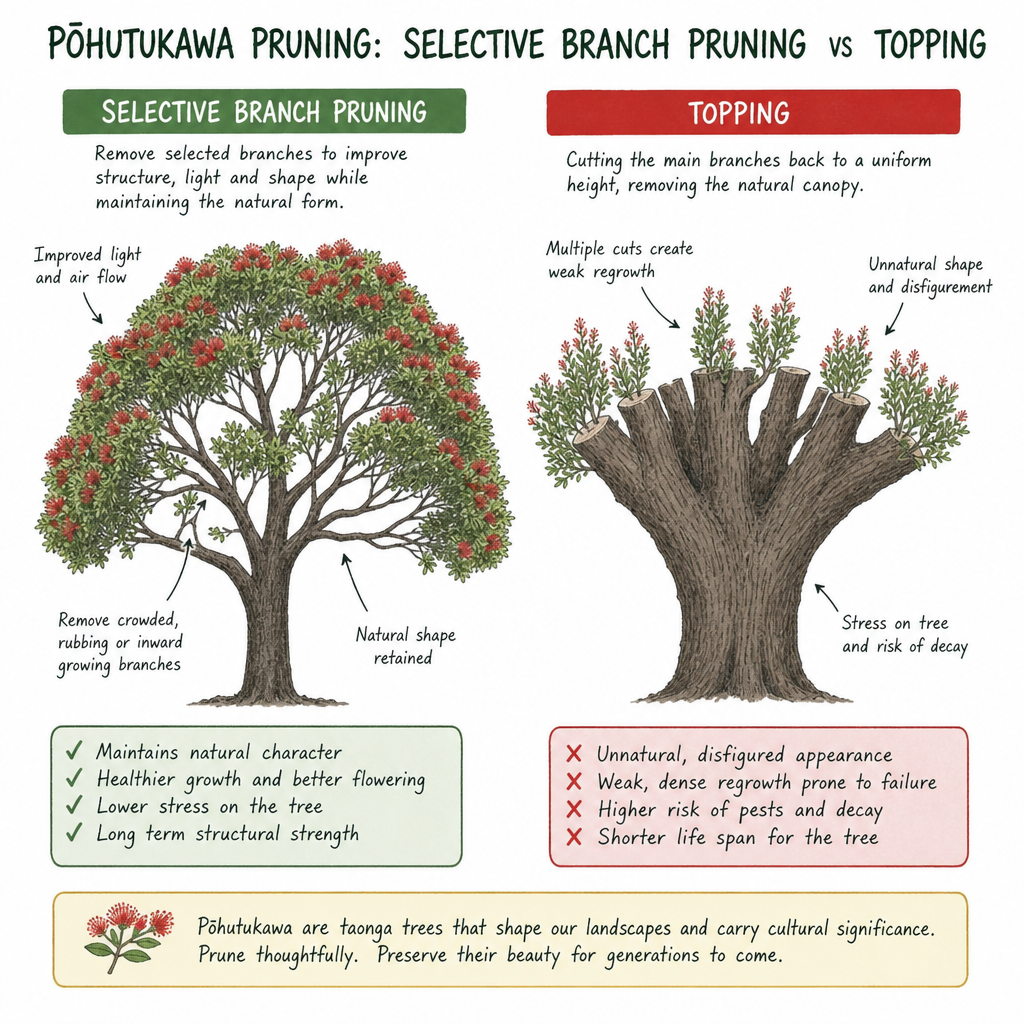
For a tree blocking sunlight, request an assessment of selective pruning rather than assuming major height reduction is necessary. For overhanging branches, discuss the problem with the neighbour and check protection before cutting back to the boundary. Keep work near overhead lines out of DIY plans: Wellington Electricity warns against pruning trees within four metres of a power line yourself. (consumer.org.nz)
Roots, paving and litter need different responses
Root conflict is a genuine urban tree management issue, but the visible symptom should guide the investigation. Lifted paving, drainage problems and cracking near a tree should be documented before anyone proposes cutting roots. Work around a protected tree can require consent even when no branches are touched, including excavation, construction or material storage around its roots. (rea.govt.nz)
Ask an arborist and the relevant building or drainage professional to assess the problem together. Useful questions include whether infrastructure can be repaired or repositioned, whether a different surface treatment is feasible, and whether root management would compromise the tree. Wellington’s working-around-trees guidance also advises keeping construction materials, equipment and damaging runoff away from tree-protection zones. (ourauckland.aucklandcouncil.govt.nz)
A real Auckland example shows why assessment matters. On 16 September 2026, Auckland Council announced consented removal and replacement of pōhutukawa on Mary Street, Eden Terrace, following damage to property and infrastructure. Specialists had considered transplanting, root barriers, root management and infrastructure changes before concluding these were not practical long-term solutions. That decision was site-specific, not a blanket justification for removing trees near paving. (ourauckland.aucklandcouncil.govt.nz)
Treat leaves and flowers as a separate maintenance problem. Consider gutter-cleaning access, suitable guards and regular sweeping before proposing canopy work. Do not assume seasonal litter creates permission to prune or remove a protected tree; the applicable planning requirements still need to be checked. (pncc.govt.nz)
Myrtle rust and storm damage require a pause
Myrtle rust attacks soft new growth, including shoots, leaves, buds and flowers. Look for yellow-orange powdery pustules, distorted growth and dieback. If you suspect infection, avoid touching the affected material or collecting samples, and photograph the symptoms instead. DOC encourages reporting observations through iNaturalist to help track the disease. (doc.govt.nz)
Do not load suspect branches into a trailer and take them elsewhere without disposal advice. Myrtle rust spores can travel on equipment and clothing, and landowners must take care not to deliberately spread this unwanted organism. Tell the arborist about suspected infection before the visit so handling and disposal can be planned appropriately. (doc.govt.nz)
Storm damage also needs assessment rather than an assumption that protection no longer applies. Keep people away from unstable limbs and contact the council and an appropriately equipped arborist. Emergency provisions have conditions: Wellington’s TREE-S2, for example, requires works-arborist involvement and council advice at least one hour before qualifying work begins. Ask which pathway applies rather than treating ordinary maintenance as emergency work. (nzarb.org.nz)
Make the decision tree-specific
The safest approach in either city is straightforward: establish ownership, confirm protection, define the problem and commission only the work that is authorised and necessary. Auckland’s numerical pruning limits and Wellington’s purpose-based pathways are different tools—not interchangeable permissions. Before arranging tree trimming or removal, send the relevant council your address, photographs and proposed scope, then agree a compliant plan with your arborist. (aucklandcouncil.govt.nz)